

Insights
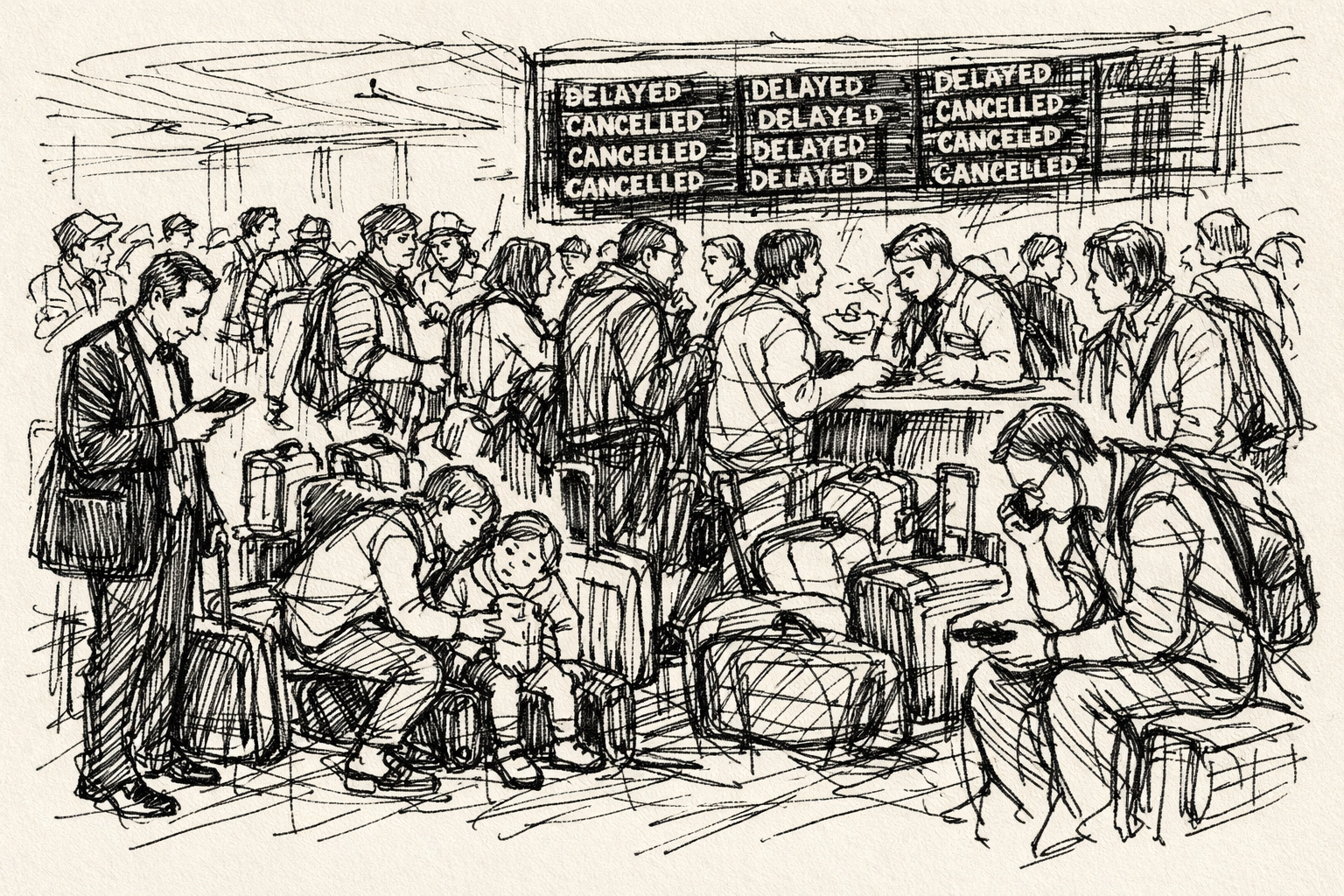

If your company relies on international travel, this is what you need to know—fast.
By the end of this article, you’ll understand:
The 2026 Middle East airspace closure is not a regional issue—it is a global aviation disruption. Airspace restrictions across multiple countries have impacted one of the most critical flight corridors connecting:
For companies, this means:
In practice, what was once a routine international trip is now a multi-variable planning challenge.
In early 2026, escalating conflict across the region triggered widespread airspace restrictions. Countries including Iran, Iraq, Israel, Jordan, Qatar, and the UAE imposed full or partial closures, effectively shutting down one of the busiest aviation corridors in the world.
Major hubs such as Dubai and Doha were heavily affected, disrupting the operations of leading carriers like Emirates, Qatar Airways, and Etihad Airways.
The immediate fallout was significant:
Airlines quickly adapted, but the alternatives came at a cost.
Flights that once passed efficiently through the Gulf are now being diverted:
These adjustments add 2 to 5 hours per journey, increasing fuel consumption, operational pressure, and ultimately, ticket prices.
 For businesses, the disruption is not just about delayed flights—it’s about compounding operational friction. Travel managers are now dealing with a new baseline where:
And behind every itinerary is a real person navigating that complexity.
Employees are experiencing longer journeys, uncertain connections, and limited support when disruptions occur mid-trip. For organisations, this puts duty of care under real pressure.
The impact tends to show up in three key areas:
What makes this disruption particularly challenging is its indirect reach.
Even companies with no operations in the Middle East are affected. Think:
A London-to-Singapore trip.
A Kuala Lumpur-to-Frankfurt route.
A Sydney-to-Nairobi connection.
All of these rely—directly or indirectly—on the same corridor. When that corridor tightens, the entire system feels it.
Beyond the headline numbers, it is worth understanding the specific cost categories that businesses are absorbing as a result of the disruption:
Rerouting premiums: airlines operating longer routes are passing through fuel surcharges and capacity-constrained pricing. A Europe-to-Asia business class fare that cost $4,000 via Dubai may now cost $5,500 to $6,500 via Istanbul or the northern route.
Extended transit times: longer journeys mean more time out of the office, more hotel nights, and more meals. A trip that previously required one night in transit may now require two.
Emergency rebooking fees: travellers caught mid-journey faced rebooking fees, penalty fares for last-minute alternatives, and premium pricing on limited availability.
Accommodation costs: hotels near major airports in transit hubs like Istanbul, Mumbai, and Singapore saw rate spikes of 40 to 80 percent during the initial disruption period as stranded travellers competed for limited rooms.
Productivity losses: employees stranded for 24 to 48 hours, or travelling an additional 5 hours each way, represent significant lost productivity. For senior employees, the cost of time can exceed the cost of the travel itself.
Cancelled meetings and deals: trips that were postponed or cancelled due to the disruption represent lost business opportunity. While hard to quantify, this is often the largest single cost category for companies with active deal pipelines in affected regions.
For a mid-sized company with a regular travel programme through the Gulf corridor, the monthly cost impact of this disruption can easily run into six figures. For large enterprises with hundreds of travellers per month transiting the region, the impact is proportionally larger.
This is not the first time airspace closures have disrupted global aviation, and the patterns from previous events offer useful guidance for how companies should respond.
In 2010, the eruption of Iceland's Eyjafjallajokull volcano closed European airspace for six days, grounding over 100,000 flights and stranding 10 million passengers. The economic cost was estimated at $5 billion. Companies that had centralised travel management systems were able to locate and rebook affected travellers within hours. Those without centralised systems spent days trying to figure out who was where.
In 2014 and again in 2022, conflict-related airspace restrictions in Eastern Europe forced rerouting of thousands of flights. Airlines that had pre-planned alternative routes were able to resume operations faster. Companies that had flexible booking policies and relationships with multiple carriers adapted more quickly than those locked into rigid programmes.
The lesson from every previous airspace crisis is the same: the organisations that recover fastest are those with the best information, the most flexible policies, and the strongest relationships with multiple travel suppliers. The current Middle East disruption is larger in scale than any of these previous events, but the principles of effective response remain the same.
Map out which employees travel through affected airspace. This is not just about final destinations. It is about transit routes. A London-to-Singapore flight that routes through Dubai is affected even though neither endpoint is in the conflict zone. A Nairobi-to-Tokyo itinerary via Doha is equally disrupted. Review the past 12 months of travel data to identify which routes your organisation depends on that transit the Gulf corridor.
If you do not have centralised travel data that allows you to do this quickly, that is itself a finding that needs to be addressed. You cannot manage risk you cannot see.
Annual policy reviews are no longer adequate for the pace of change in 2026. Companies need continuous monitoring and scenario planning for airspace closures, with pre-approved alternative routes and emergency protocols that can be activated without waiting for senior management approval.
Your policy should now include specific provisions for conflict-related disruption: pre-approved alternative routing, maximum acceptable travel time increases, emergency accommodation budgets, communication protocols for stranded travellers, and clear guidelines on when a trip should be postponed rather than rerouted.
Fragmented booking, where different teams use different agents, online travel agencies, or consumer platforms, makes it nearly impossible to track and rebook affected travellers quickly. When a disruption hits, the first question is always "who is affected?" If you cannot answer that question within minutes, your response will be too slow.
A centralised travel management platform gives you the visibility and control to respond in hours, not days. All bookings are in one system. All traveller itineraries are visible. All rebooking options can be assessed from a single interface.
Make sure employees know what to do if they are stranded: who to contact first, how to access emergency support, what expenses are pre-authorised, and how to stay safe in an unfamiliar transit city. This briefing should be standard for any trip that transits affected or potentially affected airspace.
Consider providing travellers with a physical card or digital reference with emergency contacts, your organisation's 24/7 support number (if you have one), and local embassy information for their transit and destination countries.
Standard corporate travel insurance may not cover conflict-related disruptions. Many policies have exclusions for war, civil unrest, or government-mandated airspace closures. Review your policy terms now, not after the next incident. If your current coverage is inadequate, speak with your insurance broker about conflict-extension riders or specialised travel risk policies.
If your organisation has historically relied on Gulf carriers for intercontinental routes, now is the time to build relationships with alternative airlines. Turkish Airlines, Singapore Airlines, Cathay Pacific, and several European carriers are handling increased demand on rerouted services. Having corporate agreements with multiple carriers gives you flexibility when one route is disrupted.
Not every meeting needs to happen in person, and not every trip is worth the current risk and cost premium. Establish a framework for evaluating trip necessity that considers the current disruption environment. High-value client meetings and deal closings may justify the complexity. Internal reviews and routine check-ins may not.
 There is no clear timeline for stabilisation. Airspace restrictions across the Gulf corridor are being introduced and lifted rapidly, depending on regional developments. As a result, airlines are operating in a state of continuous adjustment rather than normal scheduling.
What is emerging is not a temporary disruption — but a prolonged phase of intermittent volatility in global routing.
For corporate travel teams, this effectively changes the baseline. Planning can no longer assume route certainty through the Gulf corridor.
Instead, the operating model now looks like this:
In this environment, the companies that stay resilient are those that treat flexibility as infrastructure — not an exception.
That means:
Ultimately, the shift is less about reacting to a single crisis — and more about adapting to a new operating reality in global business travel.
What does not change is the core responsibility: protecting travellers, maintaining continuity, and making decisions based on live conditions rather than static assumptions.
Which countries have closed their airspace?
Iran, Israel, Iraq, Jordan, Qatar, Bahrain, Kuwait, and the UAE have all fully or partially closed their airspace at various points since the conflict escalated in late February 2026. The status of each country's airspace changes frequently, so always check real-time aviation NOTAMs (Notices to Air Missions) before booking.
Are flights through Dubai and Doha still cancelled?
Major Gulf carriers suspended operations during peak conflict periods. Service is being restored intermittently, but short-notice closures continue in response to active developments. Always check airline status in real time before booking or departing.
How are airlines rerouting flights?
Long-haul flights that normally transit the Gulf corridor are being rerouted either north via the Caucasus-Afghanistan route or south via Egypt-Saudi-Oman. Both alternatives add significant flight time (2 to 5 hours depending on the route) and increase fuel costs.
What does this mean for flight prices?
Fuel surcharges, longer routes, reduced capacity, and high demand on alternate routes are all pushing fares up. Transit hub hotels in cities like Istanbul, Mumbai, and Singapore are also seeing rate increases due to the influx of rerouted travellers.
Should we cancel all Middle East travel?
Several countries in the region are under Level 4 (Do Not Travel) advisories from multiple governments. For other affected countries, evaluate on a case-by-case basis using real-time risk intelligence and your national government's travel advisories. Some parts of the region remain operational but with increased risk.
How can we track which employees are affected?
Centralised travel management platforms provide real-time traveller location data based on booking itineraries. If your organisation books through fragmented channels, this visibility gap is a serious duty-of-care risk that should be addressed immediately.
What is duty of care in this context?
Duty of care refers to an organisation's legal and ethical obligation to protect employees during business travel. This includes knowing where they are, providing timely safety information, having emergency response plans, and offering support when things go wrong.
How long will the airspace closures last?
There is no clear timeline. Closures are being implemented on short notice in response to active developments and are likely to continue for as long as the situation remains unstable. Plan for an extended period of intermittent disruption.
Are travel insurance policies covering this?
Many standard corporate travel insurance policies exclude conflict-related disruptions. Check your specific policy terms and speak with your broker about conflict-extension coverage if your current policy is inadequate.
What should our updated travel policy include?
Pre-approved alternative routes, emergency contact protocols, real-time risk monitoring requirements, traveller communication procedures, emergency accommodation budgets, trip necessity evaluation frameworks, and clear expense guidelines for disruption scenarios.
How are cargo and supply chains affected?
Air freight rates on Europe-Asia lanes spiked 15 to 25 percent in the first two weeks of the disruption. Companies that depend on air cargo through the Gulf corridor are experiencing delays and cost increases that may persist for the duration of the closures.
What alternative transit hubs are available?
Istanbul, Singapore, Mumbai, and Colombo are handling increased transit traffic. However, these hubs have capacity constraints and are experiencing higher demand, so early booking and flexibility on timing are important.